How I study a river bluffcatch with MDA: one hand from start to finish
I called a river in a BXB line today, ran into top pair and lost.
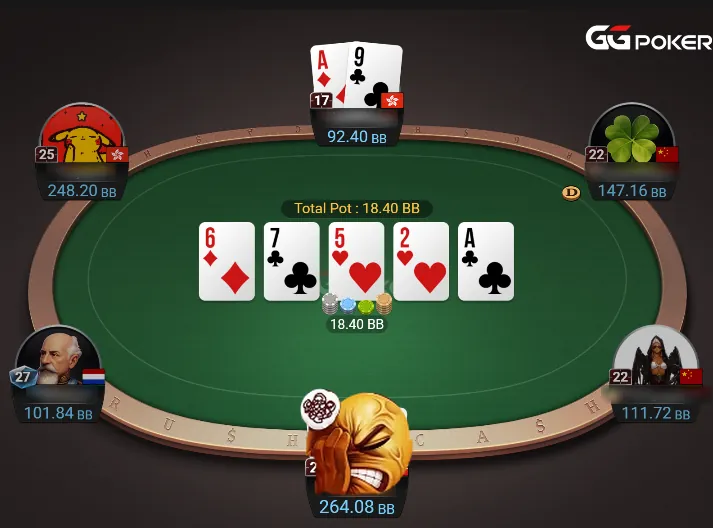
After studying the spot, the numbers said the call was good. But going back over the filters, I noticed I'd missed one that was a fairly recent addition to the app, and now I think it's a fold.
Here's how I got there: the hand, the numbers, and the part the numbers can't tell you.
Quick disclaimer: I don't think my process is perfect, and it's not the only way to study. But I think it's an efficient one. I built Redline because I wanted to study this way and thought the tool should exist, and this is how I actually use it on my own hands.
Which hands I pick to study
MDA has thousands of spots, so it can be a little hard to know where to begin.
I mostly find spots to study in two ways. One is starting from the data and looking for the spots that matter most by EV and frequency. That deserves its own article. The other is starting from a hand I actually played, which gives me a lot more motivation to understand it.
When I pick a marked hand, I try not to only pick the ones that felt close. I want frequent and impactful spots. And from time to time I check a spot where I already feel confident, to confirm or correct the places where I actually make my money.
For a long time I mainly studied the spots I felt most unsure about. I still do it a bit. It's natural, because the worst feeling at the table is running into a spot where you don't know what to do. But those spots are often rare, and often so close that call or fold barely moves your winrate.
How I think about bluff catching a river in game
I try to structure my thought process. I don't always manage it, but this is roughly how it goes.
On the flop and turn I think more theory-based. I've studied a lot of theory, so that's my foundation, and I mix exploit thinking in from there. The river is different. I still think about sizes and pot odds the way theory would, but when I'm deciding whether to call or fold a bluffcatcher, my mind goes almost straight to the exploit. If it ends up really close, a theory reason like blockers might sway it.
For the exploit, my mind goes to line and texture, then size, then player type. Size is partly covered already, because the sizing scheme is what I'm trying to recall by the river. So is player type. The whole hand through I'm trying to figure out what kind of reg he is: whether he picks theoretical sizes, how his sizes fit the board, his timings, whether his preflop stats look normal. By the river it all comes together. I also try to notice how each street felt.
In game I don't put numbers on any of this. I get a feel for how sure I am about each piece, and that pushes the decision a bit towards call or fold. The feel is only as good as the study behind it.
Away from the table I can slow down and go through each piece properly until I land on a verdict. Do that on marked hands, consistently, and your feel for these spots gets sharper. I think this is how you train your "instincts": deliberate study over thousands of spots, and real feedback on them. Getting to a sharp verdict on a hand is hard. This kind of tool makes it a lot more possible.
The hand
50NL Rush & Cash on GG. I usually play a stake below my normal game in Rush. BB vs CO 2x open with 9♠5♠. I think this is the bottom of the calling range, but probably still a call vs a 2x CO open at this rake structure.
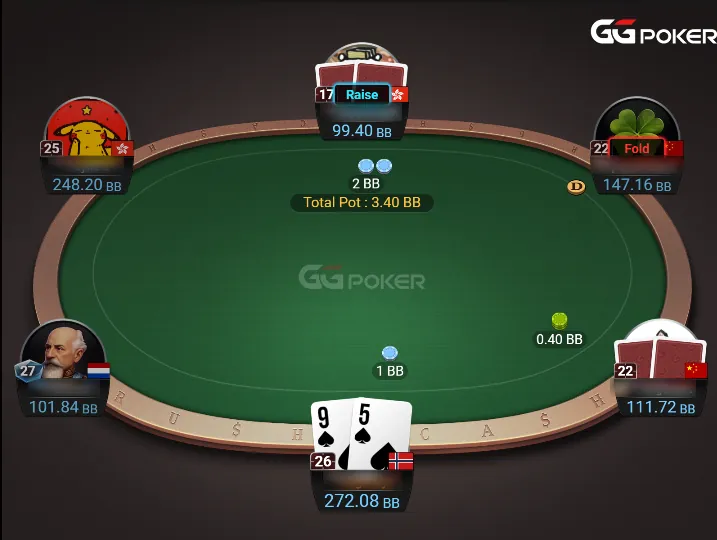
Flop 6♦ 7♣ 5♥. I face a B33, which is pretty common on this board. If you nodelock my range check, I suspect IP's c-bet range gets quite selective, maybe even close to checking back his range. That might be the type of spot where some bottom pairs with no redraw, like J5s and T5s, start folding. I'm not sure, but I suspect so. Here I have a good gutter, so this is a call, and maybe even a hand that mixes in some raises. I also think opponents can overestimate the strength of some of their hands on later streets, at least on some runouts, because relative hand strength on connected boards is hard to calibrate. That leans me towards calling with mixed hands on boards like this.
Turn 2♥. He checks back quickly. I didn't notice it much in game and didn't weigh it strongly. But a quick X back usually condenses his range at least somewhat, towards weaker hands and SDV. I'll come back to this.
River A♣. I check, he thinks for about four seconds and bets B75.
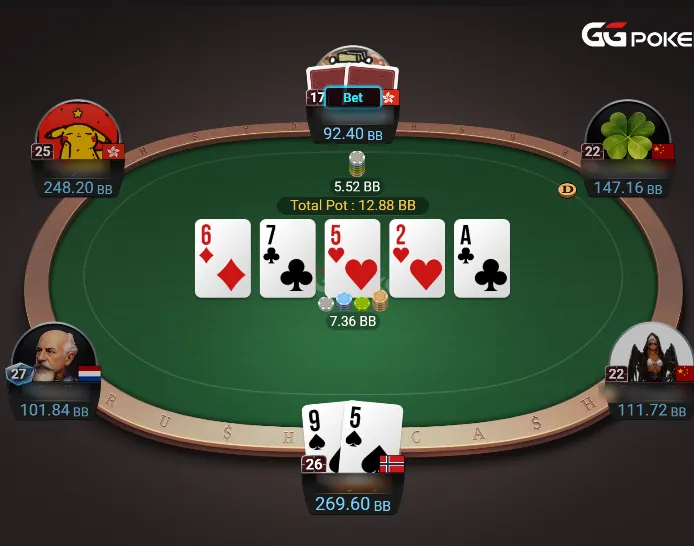
What I thought in game: BXB is generally quite overbluffed. CO vs BB doesn't change that, and his sizings look standard, so nothing moves me off that baseline. Overcard and Ace rivers in this line tend to be overbluffed more than the line overall, and so do low boards.
So I think this is a bluffcatch. I have no read on him, and I don't frequent this pool these days, so not recognising him doesn't tell me much. His preflop stats look normal on a small sample, so no reason to put him in a separate category.
The one thing on my mind: if his c-bet range should be that selective on the flop, he shouldn't have much air by the river. I haven't looked that up, though, and I'm not sure how regs at 50NL get it wrong. I think they c-bet this flop too much, but a lot of that could be value, like overpairs that theory would check more, so more c-bets doesn't have to mean more air. That's about as far as I get in game. I'm three-tabling Rush & Cash without much time bank, and how selective he should be on a board like this isn't instinct for me yet. So I fall back on what is: the line is overbluffed, and Ace rivers and low boards even more so. I think I beat the vast majority of bluffs, and I click call. The study session won't settle his flop either, but it can show whether boards like this end up less bluffed on the river.
He has A9o, and I lose this one. It is one of the value hands I'd expect to run into most often so it does not really tell me much.
Looking it up after the session
I start in Line Search to get an idea of the line. You can go straight to Texture, but the line has a huge sample, so it's the most accurate starting point.
Line Search · All regs · CO vs BB · B X B · flop B30, turn check · data from 22 Oct 2026
| River size | Weak % | Break-even | EV, % of the pot you face | Hands | Precision ±90% |
|---|---|---|---|---|---|
| B50 | 33.8% | 25.1% | +11.6% | 1.5k | ±2.0% |
| B75 | 36.4% | 29.7% | +9.6% | 4.5k | ±1.2% |
| B90 | 38.6% | 31.8% | +10.1% | 383 | ±4.2% |
Against all regs, this exact line with a B75 river: 36.4% weak on 4.5k hands, where BE is 29.7% weak. The observed EV is about +9.6% of the pot.
These tables are the app's real data for this spot, so feel free to click around: switch the player pool, open the sizes, the EV bands and the ranges.
Then the texture. This is where new MDA users can trip up: you can't stack filters that overlap. If Ace rivers are overbluffed by 15% and 9-2 high boards are overbluffed by 15%, the spot is not overbluffed by 30%. The two filters mostly describe the same hands. Usually they confirm each other, and only part of the effect adds up.
Texture Search · All regs · CO vs BB · B X B, all flop sizes · board 6♦ 7♣ 5♥ 2♥ A♣ · data from 22 Oct 2026
| Texture filter | Weak % | Sample | Avg size | EV, % of the pot you face | Precision ±90% |
|---|---|---|---|---|---|
| Overall line | 34.0% | 12.6k | 71% | +8.5% | ±0.7% |
| Turn Low — 9-2 high flop | 43.6% | 686 | 72% | +21.0% | ±3.1% |
| Flop 9-2 high | 38.4% | 2.1k | 69% | +14.6% | ±1.8% |
| River OC (9-2 high board) | 38.4% | 870 | 71% | +14.0% | ±2.7% |
| River Ace | 36.4% | 1.2k | 69% | +11.9% | ±2.4% |
| Flop rainbow | 34.1% | 5.6k | 70% | +8.7% | ±1.1% |
| River unpaired | 33.9% | 6.1k | 70% | +8.7% | ±1.0% |
| River missed flush (rainbow flop) | 33.7% | 3.1k | 70% | +8.0% | ±1.4% |
| Flop unpaired | 33.3% | 10.4k | 70% | +7.7% | ±0.8% |
| River Ace present | 32.4% | 4.6k | 69% | +6.7% | ±1.2% |
| Flop connected straight | 29.5% | 1.5k | 69% | +2.8% | ±1.9% |
The overall line here is 34.0% weak (all flop sizes). The filters I looked at first all sit above it: 9-2 high flop 38.4%, river overcard on a 9-2 high board 38.4%, Ace river 36.4%, and low turn on a 9-2 high flop 43.6%. The deuce is about the blankest turn there is, and it shows. All overbluffed, all pointing up from the line. Remember that, because it's not the whole list.
We're building a model that measures how overlapping filters combine across a ton of spots. It's still in beta and not something I'd lean on yet, but the general principle is clear: when filters point the same way, the spot is more overbluffed than the line alone, just not by the sum of them.
This is vs all regs, not GG only. I checked GG too, and the trend is the same, just slightly less bluffed. GG regs are a bit tighter, and the samples are smaller per texture, but the precision is still decent. Switch the player pool above and see for yourself.
Last, I check the river size inside the filter. The filter shows the average across all sizes in the line, so I want to make sure B75 isn't an outlier hiding behind very overbluffed other sizes. It isn't: B75 on an Ace river is 36.7% weak on 643 hands, right in line with everything else. The blue bar shows the 90% window, so you can see how wrong the number could realistically be.
River Ace, by river size · All regs · CO vs BB · B X B · data from 22 Oct 2026
| Size | Hands | Weak % | EV, % of the pot you face |
|---|---|---|---|
| All sizes (69% pot) | 1.2k | 36.4% | +11.9% |
| ≤40% pot | 192 | 27.6% | +11.3% |
| B50 | 181 | 39.2% | +18.9% |
| B75 | 643 | 36.7% | +10.0% |
| B100 | 62 | 37.1% | +6.0% |
| B125 | 31 | 29.0% | Sample too low |
| B150 | 41 | 58.5% | Sample too low |
| B175+ | 10 | 60.0% | Sample too low |
After this first pass the spot looks clearly overbluffed: somewhere around 37–39% weak where I need 29.7%.
So was I just unlucky?
The numbers look great. And we still expect to lose a lot of these calls, since we got a great price. You could stop here. Studying like this, learning which spots are overbluffed and underbluffed, will improve your winrate a lot over time.
But if you want to become elite, this isn't where it ends. The data is a starting point, not the answer, just like theory isn't. Luckily, that's what keeps poker alive despite good study tools. You still have to put in the work and understand the nuances of the spot.
His range. He has plenty of 8x and 9x that are natural flop c-bets. Vs a BTN open this is much more of a call, because BTN has a lot more offsuit 9x like K9o, Q9o and J9o. CO may still have some of those, but much fewer. K9o is a mix at a lot of stakes, while J9o and Q9o probably shouldn't be there at all. Still the suited combos, and some pure overcard air.
Low pairs. In this line the app counts every low pair as weak, and low pair means third pair or lower. On this board that's 6x and lower, so with 95 some of them beat me. I didn't think about that in game or in my first pass, but a rough combo count suggests it matters little here. The low pairs that beat me are K5s, Q5s, K6s and Q6s, only 10 combos, and with some showdown value I'd expect most of them to check the flop or the river rather than bet, so probably only one or two reach this spot. The ones I beat are 44 and 33, 12 combos. With their redraws I'd expect them to c-bet the flop more often and to be more tempting river bluffs, so my rough guess is three or four combos. If that's anywhere close, the low pairs that beat me are a small part of his range, and the weak % is roughly right for my hand. On other boards that may not hold, so it's worth a quick count. (In Line Search and drills we've calibrated where low pairs are mostly thin value and take them out there. Texture Search always counts them as weak.)
You can check the low-pair % on any spot, and the purple span on the EV band shows how far the EV moves between every low pair being value and every one being weak.
The turn timing. He checked back within a second. After thinking about it, it doesn't change my decision much, and I have to be careful about confirmation bias once I've seen the hand. But it makes sense. After I call flop, a lot of players are careful about barreling pure air, and they might X it back that quickly. I doubt 0 SDV hands like Q8s, J8s, Q9s and some K8 and K9 snap X as often. They're natural barrels for a lot of players, so I give them less weight. Not removing them, just a lot fewer combos.
Two kinds of regs. This is the crux. I think 9-7-2 is the type of board where this line gets easily overbluffed. 5-6-7 is in the same 9-2 high filter but probably drags the bluff % down. Straight-connected boards are fairly rare, so they don't move the 9-2 high filter much, and we can't draw strong conclusions about them from it.
So I think there's a distribution of regs. One group still c-bets a chunk of air on this flop, and against them this spot is clearly overbluffed. The other group knows how selectively to c-bet here. They have lots of 8x and 9x, and with that turn timing they don't have much air left by the river, while A8 and A9o, with all their offsuit combos, end up dominating the range. Against them the spot can be massively underbluffed, and I'm losing a lot.
I honestly don't know how big each group is. Say about 25% of regs are in the careful group. My guess is the spot becomes close to neutral.
Then I found the filter I'd missed
When I went back to the texture list to check this theory, I found a filter I had scrolled straight past: Flop connected straight. It came in with this month's data update, along with a lot of other new filters, and I hadn't used it yet. Yes, I built the tool, and I still missed one.
It's 29.5% weak on 1.5k hands, ±1.9%, at the filter's average size of B69. That's still +2.8%, inside the neutral band but on the positive side. At B75 specifically it's 31.7% weak with decent precision, where BE is 29.7%, so again about +2.8%.
Flop connected straight, by river size · All regs · CO vs BB · B X B · data from 22 Oct 2026
| Size | Hands | Weak % | EV, % of the pot you face |
|---|---|---|---|
| All sizes (69% pot) | 1.5k | 29.5% | +2.8% |
| ≤40% pot | 287 | 19.2% | +0.9% |
| B50 | 275 | 24.0% | −1.4% |
| B75 | 754 | 31.7% | +2.9% |
| B100 | 71 | 31.0% | −3.1% |
| B125 | 57 | 42.1% | +10.2% |
| B150 | 78 | 47.4% | +15.4% |
| B175+ | 15 | 66.7% | Sample too low |
It's not the exact answer either. Flop connected straight also includes a lot of higher, broadway-ish connected flops, which may play quite differently from 5-6-7 and could be a lot worse. Compared to the other low-board filters, though, I think it points in the right direction and gives a pretty decent estimate. And the Ace river adds some on top, since those two filters don't overlap heavily. Put together, I land at about +5 to +8% as my default for this spot.
So my theory was right, and the effect is bigger than I expected. The 9-2 high filter mixes boards like 9-7-2, which get bluffed a lot, with connected boards like 5-6-7, which don't. The connected flop pulls this spot from the +10 to +15% my first pass suggested down to about +5 to +8%. Still overbluffed, just a lot less.
How the rest of the list fits in, following the combining principle from above:
- River Ace (36.4%) still says quite a bit. It's a real pull upwards, and it doesn't overlap much with the connected flop, so part of it adds on top. That's a big reason my default is +5 to +8% and not lower.
- Flop unpaired (33.3%) and River missed flush (33.7%) are broad and sit about at the line. They barely move this spot. Since the line itself is overbluffed, if anything they nudge it slightly that way.
- River Ace present sounds like it should fit, but it doesn't. It mixes in all the Ace-high flops, which get bluffed a lot less, so it acts very differently from an Ace landing on the river. I leave it out.
Two lessons I'm taking from this:
- Scroll the whole filter list. The filters that confirm what you already think are the easy ones to stop at.
- Weigh the most specific filter most, but not blindly. Broad filters average across very different boards. The one closest to your board usually tells you the most, but check what else it includes.
So was it a call?
Without the timing tell, my default for this spot is now about +5 to +8% EV, not the +10 to +15% my first pass suggested. Vs GG regs, take a couple of percent off that. Still a call.
With the timing tell, I actually think this is a fold now. Not because selective regs suddenly got more common, but because the normal spot is a lot less profitable than my first pass suggested. From +5 to +8%, it takes far fewer selective regs to push the spot to neutral or worse. Then add the snap X back on the turn, which is exactly what removes the 0 SDV hands that would turn into river bluffs. Starting that close to the edge, it gets bad fast.
I didn't weigh the timing in game. That's the read I'm taking with me.
Did my decision matter?
Yes and no. It was still a valuable exercise. I have a sharper read on this spot now. Vs a different player type, or vs LJ or HJ, and with this timing tell, I think I'll find a fold next time. Vs BTN I'm likely still calling, but with this timing tell that one gets a lot closer too. That would need another look at the BTN numbers specifically, and how much the tell moves them. Spots where the flop is less connected get easier too. We may have found roughly where the threshold between overbluffed and underbluffed sits for this line and type of texture, and that makes similar-looking spots easier to decide.
This is usually where my study of a spot ends. But here is one more exercise: how many selective regs does it take to make this a fold?
Optional: putting numbers on the distribution
None of this is necessarily accurate. It's practice in thinking about reads as probabilities, and those guesses get sharper over time. I learned the concept from a high-stakes pro and I'm still working on it myself. You don't do this math in game, but doing it while studying teaches you which way a spot leans, and which category to file it under.
Facing B75, BE is 29.7% weak. Say the normal reg on this board is my default from above, +5 to +8%, which is about 33–35% weak, and the selective regs are about 15% weak.
| Group | Weak % on this river | Call EV, % of the pot you face |
|---|---|---|
| Normal reg (my default for this board) | about 33–35% | about +5 to +8% |
| Selective flop c-bet: checks most Ax, bets A8 and A9, little air left | about 15% | about −21% |
How it's calculated:
- Call EV, as % of the pot you face = (weak % − BE %) ÷ (100% − BE %)
- Normal reg: (33 − 29.7) ÷ 70.3 = +4.7%, and (35 − 29.7) ÷ 70.3 = +7.5%
- Selective: (15 − 29.7) ÷ 70.3 = −20.9%
How many selective regs does it take to reach break-even? Starting from 33%: (33 − 29.7) ÷ (33 − 15) = about 18% of the pool. Starting from 35%: (35 − 29.7) ÷ (35 − 15) = about 27%. So around 20–25% selective regs makes this a 0% call, and vs GG regs, a couple of percent tighter, more like 15–20%. With my 25% guess it's already about break-even.
Compare that with my first pass. At +10 to +15% (37–39% weak), I'd have needed a third or more of the pool to be selective before the call stopped being worth it. One missed filter moved that to about a fifth.
Then the timing tell on top. For the spot to count as clearly underbluffed (−6% or worse), his range needs to be about 25% weak or less. (29.7 − 0.06 × 70.3 = 25.5.) The snap X back removes exactly the 0 SDV hands that would make up those river bluffs. Starting from a spot that's already around break-even vs my guessed pool, that's enough to make it a fold for me.
Same process, without a played hand
You don't need a hand you played to do this. Instead of waiting for the spots to find you, you can go looking for the ones that matter most: frequent lines where the pool is far from break-even. That's where most of the money is.
Drilling works at the line level, so it's the fast way to get those lines into your head. When a drill surprises you, that's a line worth taking into Texture Search and giving the same deep look as this hand. How I find the high-impact spots is its own article.
Wrapping up
One lost pot, and I went from "clear call" to "fold with this timing". Not because the data was wrong, but because I looked at more of it, and then thought about what it couldn't tell me.
That's the whole process. Start with the line. Check the texture, and scroll the whole list. Make sure your size isn't an outlier. Then put your reads on top. The data gives you the baseline. Your job is figuring out how far a read moves it, and that's the part that turns into instinct over thousands of spots.
And honestly, that's what makes poker fun. It isn't robotically playing spots by theory or by MDA. It's the problem solving: putting the line, the board, the timing and the numbers together, in every single spot. Working out what kind of player you're up against is another layer on top of that, when you have the information. That's why the game is still skillful, and why good study tools don't solve it for you.
If you want to study your own spots like this, Redline is in early access.